
Equity investors grew richer by Rs 32.49 lakh crore in 2020 on the back of smart returns in the stock market which had a roller-coaster ride during the year hit by the coronavirus pandemic. The COVID-19 outbreak ravaged lives and livelihoods on a global scale, shuttering businesses and jolting world equities. But amid all the gloom, Indian stock indices gave hope of returning to winning ways towards the latter part of the year.

The buyback price is at around 28 per cent premium to the current market price of Rs 67 on the Bombay Stock Exchange

Companies in the small-cap universe are having a dream run - the Nifty Smallcap 100 index has shot up more than 25 per cent on a year-to-date basis, even as the benchmark Nifty is up 7 per cent. This is the best start for the index since 2017 when the Nifty Smallcap 100 index surged 32.3 per cent between January 1 and May 10. However, in terms of outperformance to the Nifty, this year's performance is the best in more than a decade. A combination of sectoral tailwinds and lack of institutional selling pressure has helped small companies escape from the correction triggered by the second wave of Covid-19.

The combined profit before tax of 748 companies, which have declared their results for Q1FY21, is down 46 per cent YoY. Their net sales went down by a quarter as the Covid-19 lockdown led to a sharp fall in economic activity.

Top companies in China are valued at 7.7 times the trailing 12-month earnings against a P/E ratio of 18.6 times for Nifty 50 companies.

Analysts said the demand recovery in two-wheeler and car segments was skewed towards the semi-urban and rural markets.

Market players said a big upmove by the market will depend on policy action by the government to revive economic growth and corporate earnings revival.

Gold prices are likely to decline further to around Rs 24,500 per 10 grams by December if the rupee continues to rule at the current level.

Campus recruits can also aim to double the existing entry level package by proving their skills through the TCS national qualifier tests.

The test - called the Truenat Beta CoV test - effectively enables same-day testing, reporting, and patient isolation initiation.
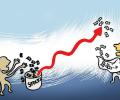
Small stocks made a dashing comeback in 2020 after delivering negative returns in the last two years as increased retail investor participation in pandemic times saw small-cap index surging up to 31 per cent and outperforming the bigger benchmark gauge. This year turned out to be eventful for the equity market, witnessing bearish and bullish sentiments at different points of time. While the initial part of COVID-ravaged 2020 saw the bears in full force amid concerns related to the pandemic and lockdowns hurting economic activities, bulls made a comeback towards the latter half of the year. As the market swayed with many lows as well as highs, small and mid-cap indices emerged as markets favourites in 2020.

The share of public sector undertakings (PSUs) in the total market capitalisation of listed companies--at an all-time low of 10 per cent currently --- may get a leg-up from the government's divestment push. Recently the government announced the successful sale of national carrier Air India to Tata Sons, India's first privatisation of a PSU since 2002-03. The transaction is expected to be completed by December.

While the market may remain volatile this year, analysts expect equities to deliver positive returns by outperforming inflation and government bonds, supported by the fiscal stimulus in the US.

According to experts, the Nifty has continued to form lower top-lower bottom formations, a trend seen in the last five weeks, and witnessed sharp selling towards 9,700 zones.

The government is expected to dole out some populist policies, especially for the rural / farm sector while presenting the interim budget, given that the country is heading towards general elections over the next few months.

Gold, which was hovering around $1,321 an ounce in January 2019, has already breached $1,600 per ounce in the past few sessions to a seven-year high.

Many investors want to exit equities now and re-enter when they begin to rise. Such timing is difficult to pull off.

While some companies, such as HSBC, have closed retail operations, big players such as India Infoline is scaling down.

Since last month, the realty (down 23%), auto (down 16%) and finance (down 14%) indices have underperformed the market by falling over 13%, as against 8% decline in the benchmark indices

In the past two months alone, four companies have garnered a cumulative Rs 22,400 crore via this route.

Technically, the Indian economy is on road to recovery.

Active subscriber base declined by 2.2 million on a month-on-month (MoM) basis to 970.2 million in August 2019, on the back of Bharti Airtel and Vodafone Idea losing customers. Jio was the only operator to add 7.2 million active subscribers in the same month.

Titan accounted for 59.6 per cent of his disclosed portfolio at Rs 8,355 crore. This is more than 10 times the next biggest holding, Federal Bank, at Rs 619 crore.

Over the past one-and-half years, the number of stocks trading below their respective face value has increased 29 per cent after a sharp correction in stocks of small-cap companies.

While weather forecasters remain divided on how the monsoons will play out in India over the next few months, analysts believe the news at the current juncture - at best - can trigger a knee-jerk reaction in the markets. They believe it is too early to say whether the sub-par monsoon on account of El Nino can seriously dent the market sentiment in the short-to-medium term. "These are just initial forecasts and we will have another round / status update from the weather forecasters a month down the line.

Equity mutual funds attracted an all-time high net inflow of Rs 28,463 crore in March, on continued interest by retail and HNI investors, who used market correction as a good buying opportunity.

Overall, the domestic FMCG market bounced back to levels of 98 in June compared with 75 in May and 101 in March before the nationwide lockdown was announced. The pre-Covid March index for foods was 103, and for non-foods, it was 99.

Stick to export-focussed plays, large-caps, say analysts

'Indians are great savers, but they are lousy investors.'

'To achieve a corpus of Rs 10 crores in the coming years, I would suggest you increase your SIP, advises Nikunj Saraf, vice president, Choice Wealth.

Auto, pharma, IT, chemicals among sectors with significant reliance on UK and European nations with Tata Motors, Motherson Sumi, Tata Steel, TCS, Wipro, Infosys and Tech M among key names.

To be able to tide over the current crisis, automobile manufacturers have waged a war against all cost heads.

Market sentiment around the stock has continued to be positive on the back of improving outlook for the US economy and anticipated weakness in the rupee.

The elections held in April-May 2019 will be an important determinant of future growth and investment.

A hotel in 1975, entry into paperboards in 1979, India's dominant cigarette maker, ITC, read the tea - or tobacco - leaves early, leveraged its enterprise strengths and stepped up the diversification agenda to create multiple drivers of growth. Some failed, some faltered, some were transformational, adding steadily to the top line. Now those efforts are making a difference: margins from non-cigarettes - FMCG, hotels, agri, paperboards, paper and packaging - are expanding and profits are kicking in more significantly than ever before.

Attractive pricing coupled with improving prospects make the offer lucrative

Outflows are likely to continue, experts say, till such time as the markets see a significant correction.

Given the developments, analysts expect fiscal and monetary support from the government and RBI to revive sentiment. However, recovery, they say, from these levels will be slow and painful.

A joint venture of Synbiotics, a wholly owned subsidiary of Ambalal Sarabhai Enterprises (ASE), and CoDiagnostics, CoSara Diagnostics is the first and only Indian company so far to receive a licence from the Central Drugs Standard Control Organisation (CDSCO) to manufacture coronavirus diagnostic test kits.

The social impact of this could be worse as 300 million subscribers may face the annoyance of network shutdown and churn.
